
I grew up on a farm in southern MN, went off to college and got an engineering degree, worked as an engineer for 40 years, retired and moved to Pt. Judith, Ri, and took up surfcasting. The same principles that I learned in farming and engineering apply to fisheries.
The beginning of civilization was agriculture. People learned that they could plant seeds that were edible and grow more food that they could eat. The important thing was that they had to save seeds that they could plant the next year. That worked for a while, but after a few years, the soil became depleted of nutrients. This was not sustainable. After the pilgrims landed at Plymouth, Squanto taught the pilgrims how to grow corn, and to fertilize each hill with a fish, either a herring or a menhaden. This was now a sustainable process. Maybe Squanto told them, or later farmers discovered the concept of “Optimum Yield.” If the hills were crowded too close together, the yield would decrease because the plants would compete for sunlight, water and nutrients. The horse-drawn corn planter was invented in 1834. My dad got one around the 1930’s that planted 2 rows at a time and had rotating plates that had notches on the outer edge that were just large enough to hold about 3 kernels of corn. The plates were driven by a shaft that was geared to the planter’s axel and would rotate from under a bin of corn and pick 3 kernels and drop them down a tube that went between a couple of discs that separated the soil. Fertilizer was also added at the same time by a similar mechanism. The gearing from the wheels were designed so the hills were spaced at the proper distance. Yields could also be improved by “crop rotation,” which improves the quality of the soil. The crops grown on a piece of land was changed every year, from corn , to soybeans, then oats was planted along with clover and grass seed. The oats would be harvested in July, and maybe a crop of hay could be harvested in September. The next year maybe a couple of crops of hay could be harvested and then the next year it was turned into pasture for the cows to graze. Everything possible was done to maximize the yield that could be sustained for years to come.
On the farm, we had dairy cows, pigs and chickens. Nearly all our time was spent growing and harvesting crops to feed the animals. Food was essential for the animals.
I have gone through this example to explain what maximum sustainable yield means. It means to get the maximum yields possible and sustain that yield at that level for generations to come. My grandfather bought the farm in 1910, my parents farmed there from 1927 to 1976 when he sold it and it is still being farmed today, and producing a lot more than in 1910, thanks to advances in science. Now that is what I call sustainable. In contrast this is a sample of a couple of species in our Atlantic fishery.
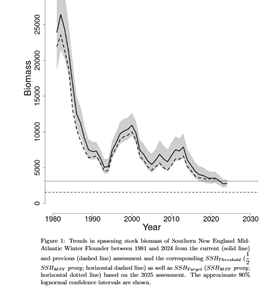
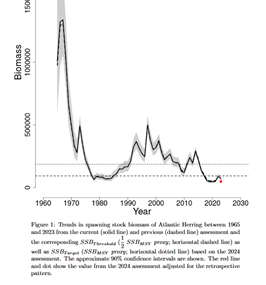
Clearly, the past management had no clue what sustainability means, or they would not have gone on doing the same thing for 50 years.
The metric that NOAA uses is whether or not the stock is overfished and if overfishing is occurring. The threshold, the dashed line in the charts above, is the benchmark that determines if the stock is overfished. For example if the curve on the bottom chart gets above the dashed line, the stock is considered rebuilt. This is what NOAA brags about in their report to congress.(link). The problem is, the “success” is about 10% of the current population. Another report that NOAA gives to their fishery management councils paints a different picture. (link).
Maybe I’m picking on NOAA too much, lets get away from that and look to the future. O n the positive side, just look at the potential in our Atlantic fishery if it were restored to levels that are shown in the two graphs above. And that’s not the limit. The starting points is those charts is after the fishery was over-fished by foreign fleets. Sometimes there were as many as 100 Soviet boats fishing the George’s bank area.
The new metric to use in managing the Atlantic fishery should be population growth, and that is described in the “Managing the Rebuilding” page.