
The Atlantic Fishery: Decline, Management, and Restoration Efforts
Overview of Atlantic Fishery Decline
In the last 50 years, the production from the Atlantic fishery has dropped about 90% and the US now imports over 70% of its seafood.
Historical Context
In 1492, Christopher Columbus discovered America. About a decade later, Portuguese fishermen began exploiting the continental shelf of North America, which soon became one of the most productive fisheries in the world, thriving for approximately 450 years. By the second half of the 20th century, fishermen from numerous countries operated in these waters. At one point, as many as 100 Soviet ships fished there, leading to overfishing.
To address these issues, Congress passed the Magnuson-Stevens Fishery Conservation and Management Act (MSA, link), in 1976. This legislation extended American sovereignty over Atlantic waters from 12 to 200 nautical miles. Management of the federal waters fishery was transferred to the Department of Commerce and NOAA Fisheries. Despite this change, production from the fishery has decreased by about 90% from historical levels and continues to decline (link). Worse still, benchmarks (see charts at end of text) for determining whether stocks are overfished have been reduced to about 10% of their historical levels. NOAA now considers these lower levels as the new norm, and there is no effort to rebuild the fishery. They celebrate rebuilding a stock when it rises above these diminished thresholds (link).
Scope of Analysis
This discussion is limited to the Atlantic fishery; other fisheries have not been examined.
Significance and Threats to Fishery Resources
According to Section 2 of the MSA, written about 50 years ago, fish off the U.S. coasts, highly migratory species of the high seas, species on or in the U.S. continental shelf, and anadromous species spawning in U.S. rivers or estuaries are valuable and renewable natural resources. These resources contribute to the nation’s food supply, economy, health, and provide recreational opportunities. However, certain stocks have declined to the point where their survival is threatened, and others are at risk due to increased fishing pressure, inadequate conservation and management practices, or direct and indirect habitat losses. The situation, already dire, has deteriorated further—but if the ocean is restored, the potential for recovery is immense, though the true limits are unknown.
Restoration Efforts and Outcomes
The only significant fishery restoration observed is the river herring recovery in Maine, which happened by accident. About 15 years ago, Maine lobstermen struggled as the Atlantic herring quota, used for bait, was exhausted by June, leaving them without bait for the remainder of the year. Three Gulf of Maine states and the Atlantic States Marine Fisheries Commission responded by closing their ports to Atlantic herring landings from January 1 to June each year within Area 1A, spanning inshore state and federal waters from the Canadian border to Cape Cod. Following this policy, river herring populations in Maine surged, with runs now numbering in the millions. River herring often mix with Atlantic herring and are caught as bycatch. During the Atlantic herring Amendment 10 hearings, a similar closure was proposed for Southern New England. The NEFMC recently decided to address this in the herring specifications framework, aiming for implementation by September 2027, which is promising news.
A similar issue exists with river herring mixing with Atlantic mackerel in the mid-Atlantic, where they are harvested together. While the same solution may not work, it is an option worth exploring.
Current Status of the Atlantic Fishery
The outlook for the Atlantic fishery remains grim. Total landings declined by 34% between 2012 and 2023 (link). From 2013 to 2022, the actual harvest of Atlantic herring dropped by 95%. The 2024 stock assessment (link) noted that “Overfishing currently is not occurring.”
Since America expanded federal waters from 12 to 200 nautical miles, populations of most species in the Atlantic fishery have steadily declined, now resting at or near single-digit percentages of historical levels, with further declines ongoing.
Populations and recruitment rates of cod, hake, flounder, mackerel, scup, herring, bluefish, and striped bass are all falling. Fewer fish means fewer eggs, and the lack of forage fish increases predation on juvenile fish, compounding the problem. This situation cannot be sustained.
Summary and Management Assessment
In summary, the Atlantic fishery has experienced a 50-year decline in fish populations, with no signs of reversal. One of the requirements of the MSA is is to maintain Maximum Sustainable Yield, which basically means to obtain the maximum yield that the ecosystem can sustain for generations to come. Clearly, this has not been done. Current low population levels are now considered the norm, and benchmarks have been lowered and fisheries are not labeled “overfished,” eliminating the impetus for rebuilding. Harvesting at these levels is not optimal nor in the nation’s best interests; management over the past 50 years has failed to sustain the fishery.
NOAA Stock Smart Resources
The following charts are from NOAA Stock Smart (link). To view them: click “browse by stock.” On the next page, use the jurisdiction drop-down menu (New England is NEFMC), then select “search stocks” to see all NEFMC-managed species. Once you choose a species, another page appears; select the link under “Final Assessment Report” to access the final report and accompanying graphs.
Note: Biomass is in Metric Tons
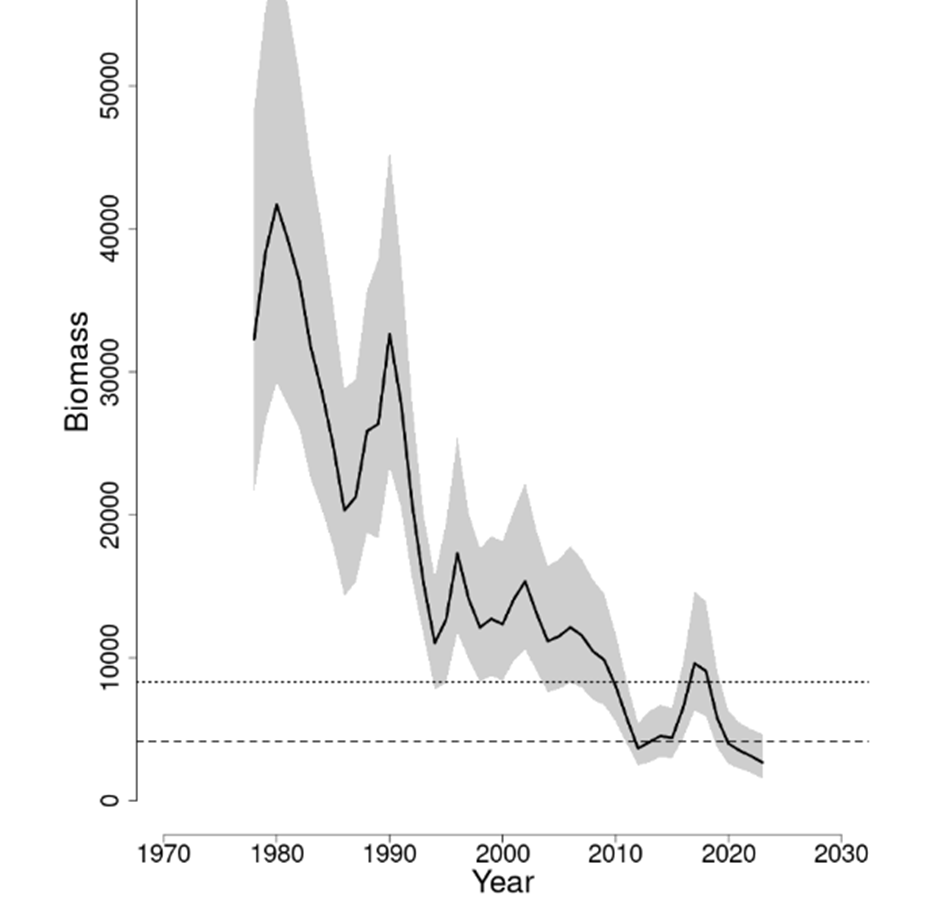
The baseline (dashed line) which would define if the stock is overfished is 4145 metric tons, or 10% of recent history high.
Stock is overfished and overfishing is not occurring
Atlantic Herring
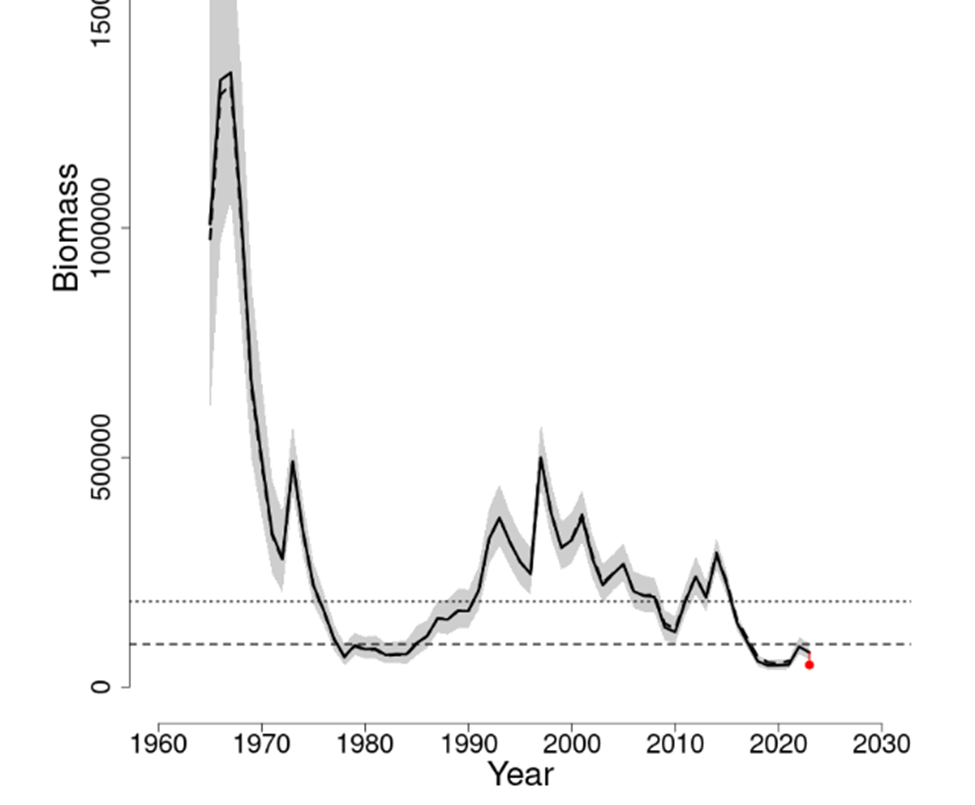
The baseline (dashed line) which would define if the stock is overfished is 73283 metric tons, or 7.7% of recent history high.
Stock is overfished and overfishing is not occurring. U.S. wild-caught Atlantic herring is a smart seafood choice because it is sustainably managed and responsibly harvested under U.S. regulations. (It is also a foundation of the marine food chain, but NOAA doesn’t think food is necessary for fish,)
Pollock
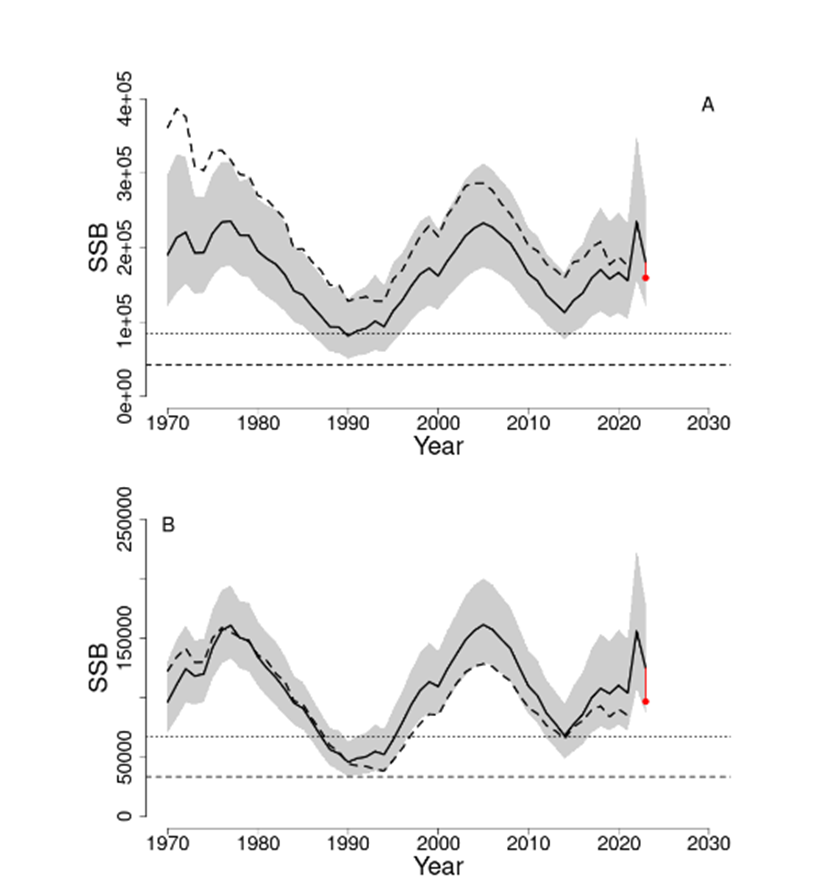
The baseline(dashed line) which would define if the stock is overfished is 42223 metric tons, which ir 17% of recent history high for A and 33516 mt, which is 25% of historic high.
Stock is not overfished and overfishing is not occurring
Cod, Western Gulf of ME
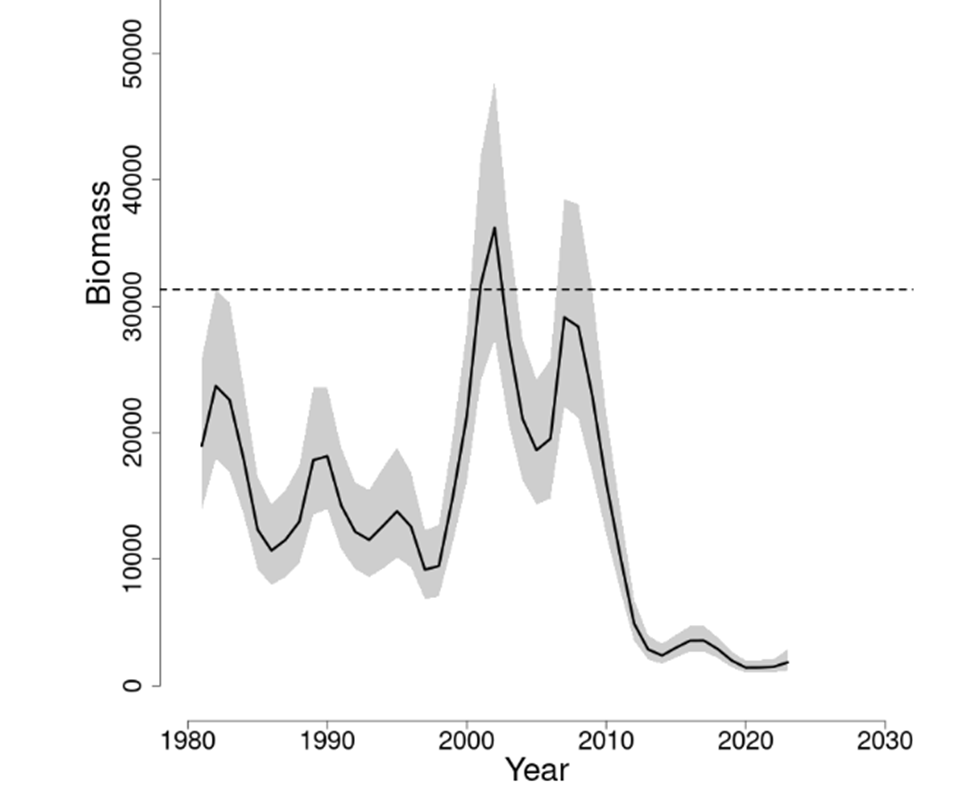
The baseline (dashed line) which would define if the stock is overfished is 33617 metric tons, or 97% of recent history high. Seems to be a bit of an outlier.
Stock is overfished and overfishing is occurring
White Hake
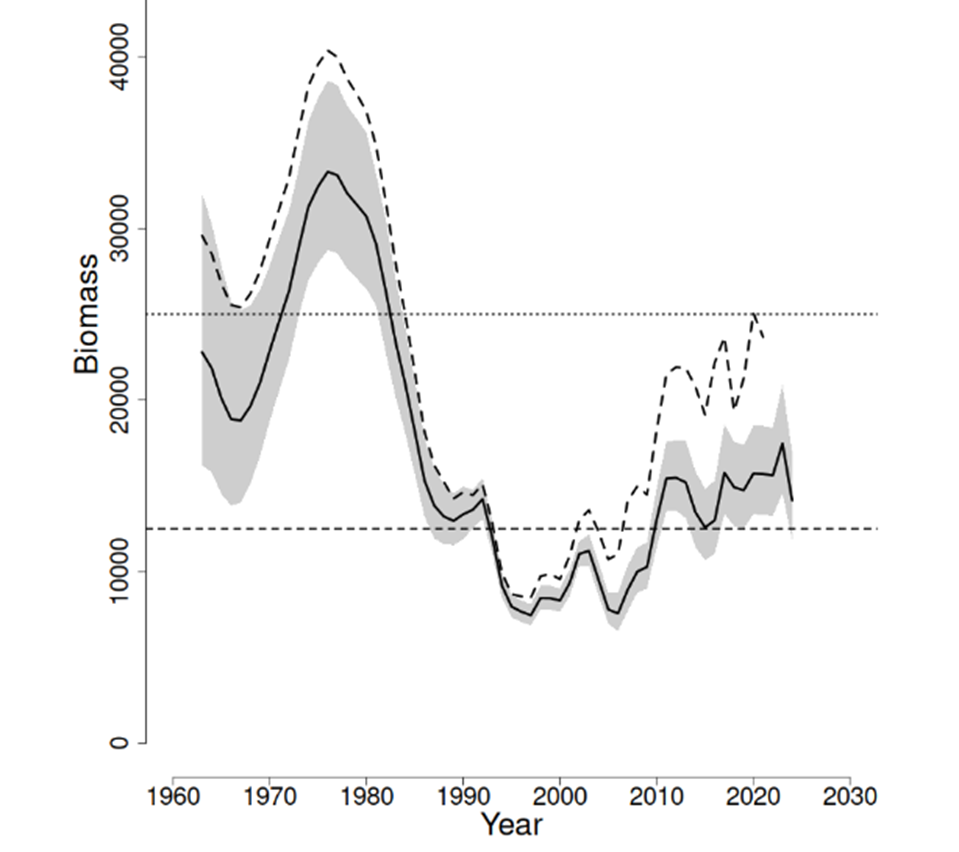
The baseline (dashed line) which would define if the stock is overfished is 12502 metric tons, or 15% of recent history high.
Stock is not overfished and overfishing is not occurring
Winter Flounder-Southern New England and Mid-Atlantic
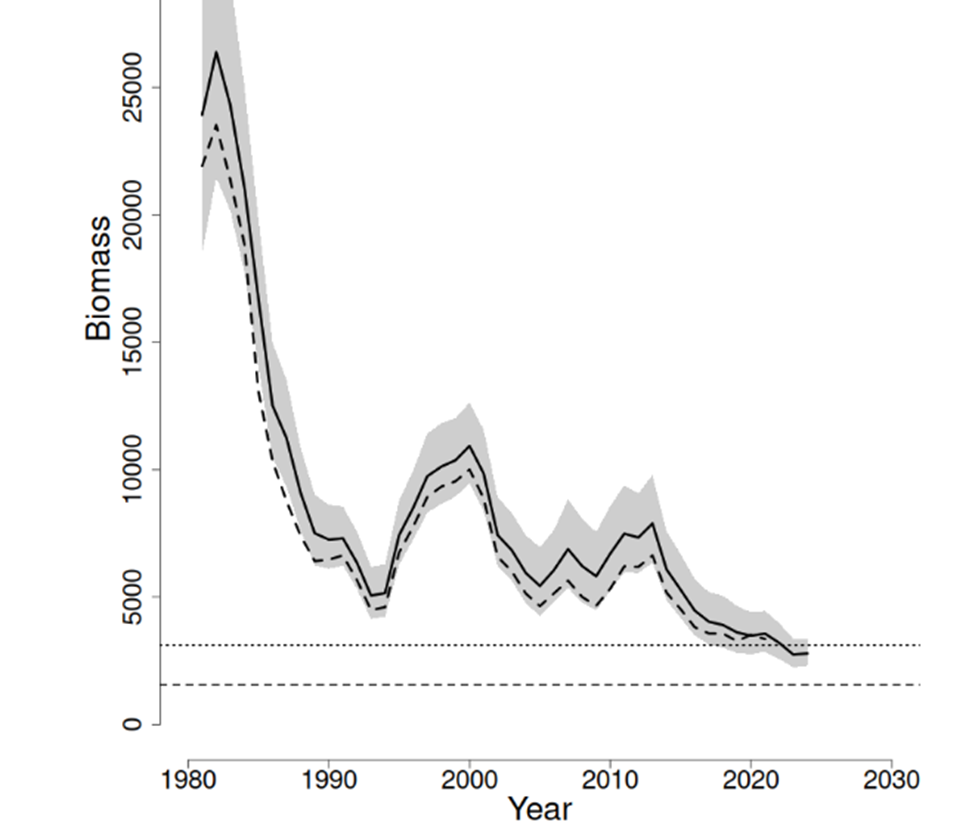
The baseline (dashed line) which would define if the stock is overfished is 1557 metric tons, or 6% of recent history high.
Stock is not overfished and overfishing is not occurring. U.S. wild-caught winter flounder is a smart seafood choice because it is sustainably managed and responsibly harvested
Yellow Tail Flounder-Georges Bank
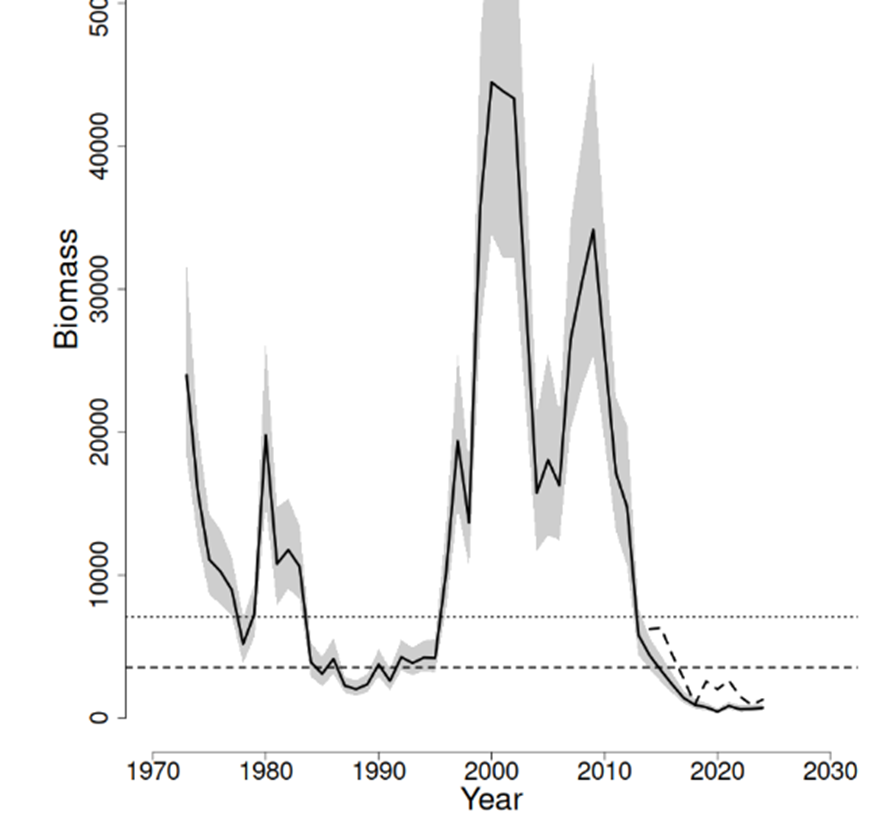
The baseline (dashed line) which would define if the stock is overfished is 3536 metric tons, or 6% of recent history high.
Stock is overfished and overfishing is not occurring.
Yellowtail Flounder-Cape Cod and Gulf of Maine
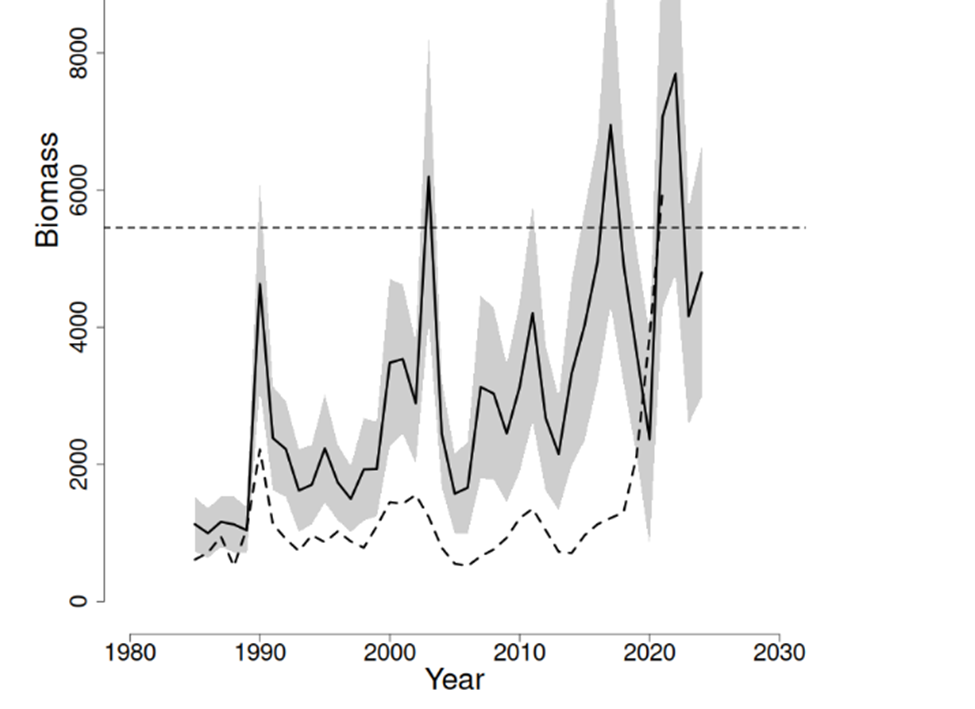
The baseline (dashed line) which would define if the stock is overfished is 5454 metric tons, or 90% of recent history high. (Another outlier)
Stock is overfished and overfishing is not occurring.
Yellowtail Flounder-Southern New England and Mid-Atlantic
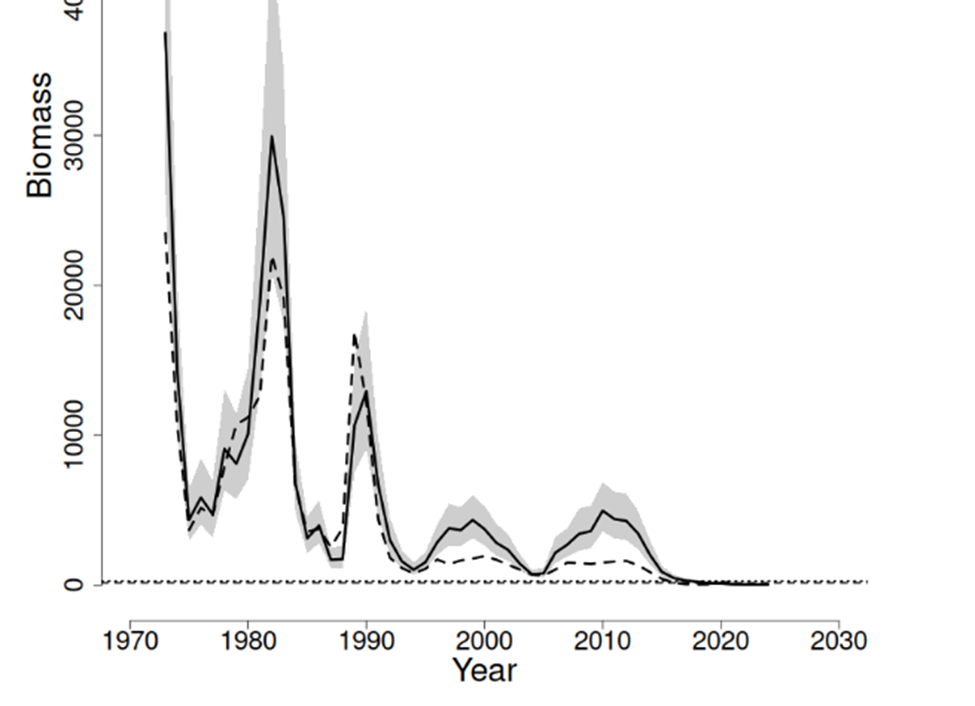
The baseline (dashed line) which would define if the stock is overfished is 135 metric tons, or 0.4%% of recent history high.
Stock is not overfished and overfishing is not occurring.
Black Sea Bass
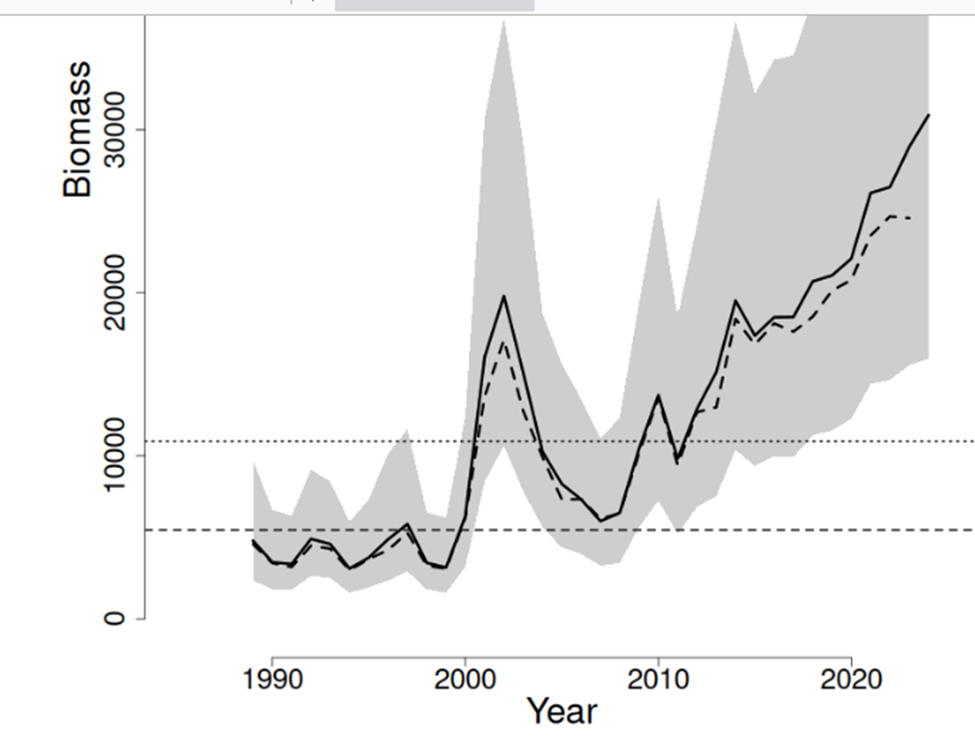
The baseline (dashed line) which would define if the stock is overfished is 5439 metric tons, or 18% of recent history high. This is the type of chart I like to see, the historical high is the current high. Just guessing, but I think the growth might be because black sea bass feed primarily on crabs and there has been an invasion of Asian crabs.
Stock is not overfished and overfishing is not occurring.
Atlantic Mackerel
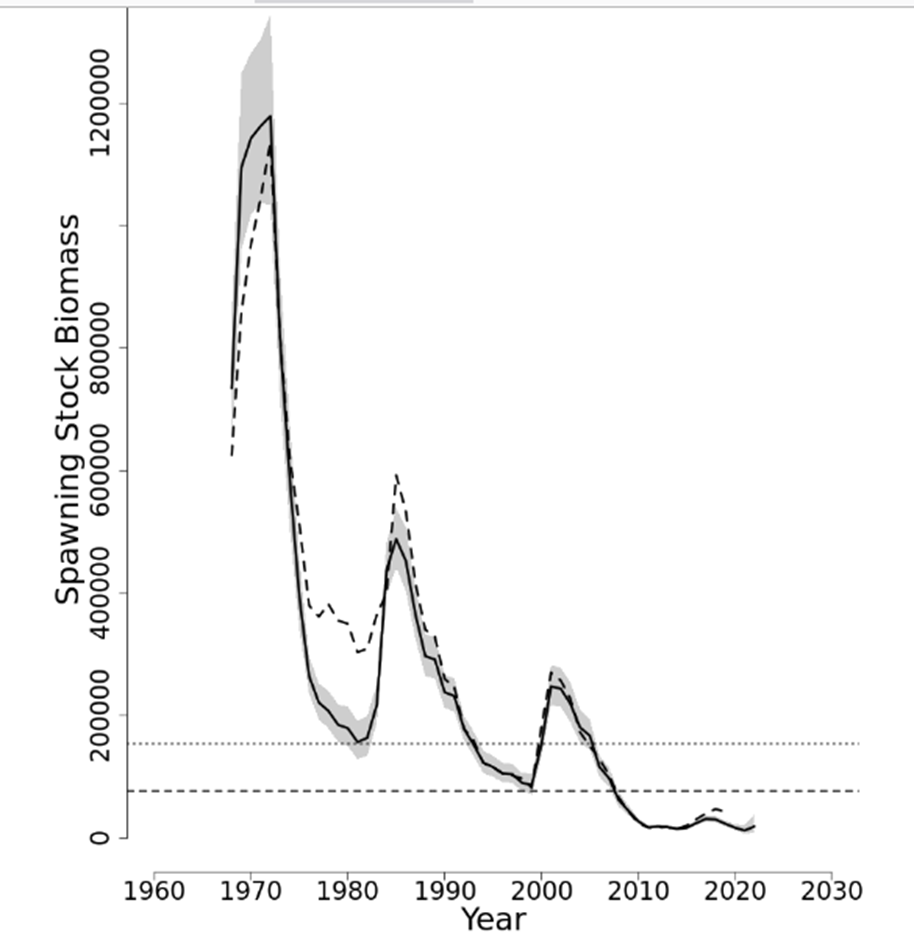
The baseline (dashed line) which would define if the stock is overfished is 77,254 metric tons, or 7.7% of recent history high.
Stock is overfished and overfishing is not occurring. U.S. wild-caught Atlantic mackerel is a smart seafood choice because it is sustainably managed and responsibly harvested under U.S. regulations. (also part of the fishery food chain)
Atlantic Bluefish
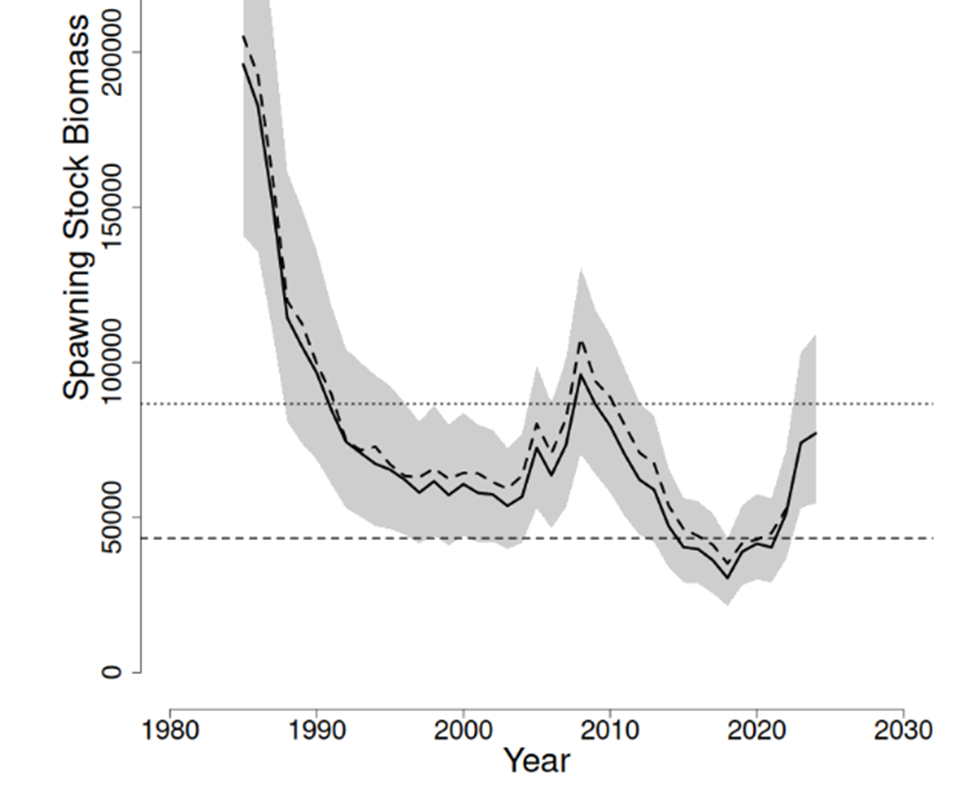
The baseline (dashed line) which would define if the stock is overfished is 43,314 metric tons, or 22%% of recent history high.
The stock is not overfished and overfishing is not occurring. U.S. wild-caught bluefish is a smart seafood choice because it is sustainably managed and responsibly harvested under U.S. regulations.
So what were things like 50 or more years ago. To find out, please go to “The Abundance Story” page.
References
MSA-https://www.fisheries.noaa.gov/s3//dam-migration/msa-amended-2007.pdf
Fisheries of the US: https://s3.amazonaws.com/media.fisheries.noaa.gov/2025-01/FUS-2022-final3.pdf
Sustainable Fisheries: https://www.fisheries.noaa.gov/topic/sustainable-fisheries
National Standards Guidelines: https://www.fisheries.noaa.gov/national/laws-policies/national-standard-guidelines